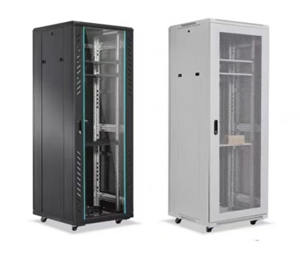
Efficient Silent Liquid-Cooled Cabinet - EMI Shielding Dustproof Near-Zero Carbon Data Center
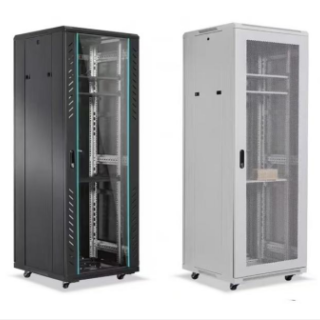
1. Superior Protection Performance: Adopts one-piece forming of cold-rolled steel plates with electrostatic spraying treatment, achieving an IP54+ protection rating. It is dustproof, moistureproof, and anti-electromagnetic interference, suitable for stable use in multiple scenarios such as indoor computer rooms and outdoor base stations.
2. High Load-Bearing & Modular Design: Boasts a static load capacity of 1000-2000kg, supporting 19-inch standard mounting positions. Modular cable management troughs and PDU (Power Distribution Unit) are detachable for flexible expansion, compatible with servers, optical cable supporting equipment, and other types of hardware.
3. Efficient Heat Dissipation Solution: Integrates intelligent temperature-controlled fans or liquid cooling modules, with heat dissipation power ranging from 6kW to 20kW. Some models feature a PUE<1.2, aligning with the "dual carbon" policy and reducing energy consumption costs of data centers.
4. Intelligent Operation & Maintenance Experience: Equipped with a remote monitoring system, supporting real-time monitoring of temperature, humidity, and energy consumption as well as abnormal alarms. Optional AI operation and maintenance modules are available to realize unmanned management and improve maintenance efficiency.
5. Compliance & Durability: Complies with international standards such as ISO and CE. The structure has passed anti-vibration and anti-impact tests, with a service life of over 10 years. Multiple color customization options (e.g., RAL7035) are provided to meet the aesthetic needs of different scenarios.
6. Space-Optimized Design: Offers multiple specifications with depths of 600-1200mm and heights of 12U-42U. Wall-mounted and floor-standing options are flexible to adapt, enabling high-density and orderly deployment of equipment even in small spaces.
Hang Zhou Jinlong Optic-Electric Co.,LtD.一 Production-content-collaboration-of-standardization-and-customization
1. Preparatory Stage: Conduct market research to clarify industry demands (e.g., high density for data centers, corrosion resistance for outdoor scenarios), complete structural design (including dimensions, load-bearing capacity, and layout of cooling modules) and scheme review. Simultaneously, procure core raw materials such as cold-rolled steel plates (key material), aluminum profiles, hardware accessories, cooling fans/liquid cooling components, and door locks, followed by incoming inspection (e.g., material thickness, corrosion resistance).
2. Processing and Manufacturing: First, achieve structural forming through CNC cutting, stamping, bending, welding, and other processes. After surface treatment such as degreasing and phosphating, adopt electrostatic spraying technology to enhance corrosion resistance and wear resistance. Embed modular components (e.g., cable management troughs, power distribution units, cooling systems) in key links to ensure compatibility and scalability.
3. Quality Inspection and Delivery: Conduct comprehensive testing on the cabinet's surface flatness, structural strength, protection level (dust and water resistance), cooling efficiency, etc. Once qualified, mark specifications and parameters (e.g., U count, load-bearing capacity, protection class IPXX), complete packaging protection, and arrange shipment according to orders.
II. Core Functions
- Equipment Protection: Provide physical isolation, dustproof, moistureproof, and electromagnetic interference shielding, resist external environmental impacts such as vibration and shock, and extend the service life of core hardware including servers, switches, and optical cable supporting equipment.
- Organized Management: Realize orderly placement of equipment and cable sorting through standardized internal space (e.g., 19-inch standard mounting positions), cable storage troughs, and layered partition design, reducing the difficulty of later maintenance.
- Functional Adaptation: Integrate cooling (fan/liquid cooling), power distribution, monitoring, and other modules to meet the cooling needs of high-density equipment operation, ensure stable power supply, and adapt to the use of different scenarios such as data centers, communication rooms, and industrial sites.
III. Industrial Significance
- Hardware Foundation Support: As the "physical carrier" of digital infrastructure, it supports the implementation of industries such as 5G, industrial internet, and AI data centers. It is compatible with core hardware including optical cable transmission equipment and server clusters, ensuring the stability of data transmission and computing.
- Adaptation to Industrial Upgrading: The R&D and production of modular, high-density, and liquid-cooled cabinets align with the "dual carbon" policy and computing power upgrading needs, helping to reduce the PUE value of data centers and promote the green and low-carbon development of the digital industry.
- Promotion of Industry Standardization: By unifying standards such as dimensions and installation interfaces, it realizes compatibility and interconnection of equipment from different manufacturers, reduces the cost of enterprise hardware deployment and expansion, and promotes the coordinated development of industries such as communications and IT